

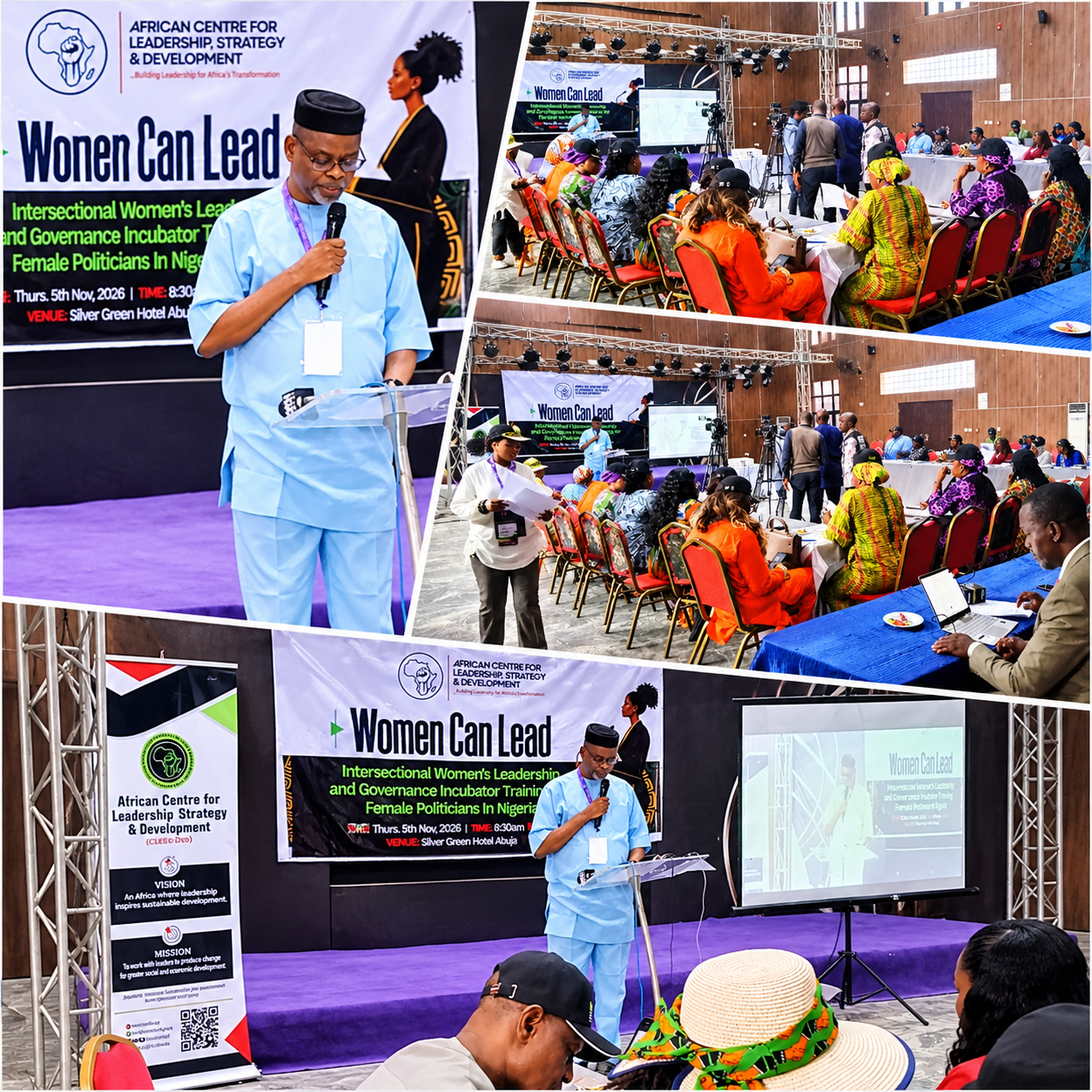
…Participants seek greater representation in power, say women can deliver better governance
By Toyin Victor ABUJA
The Centre for Leadership, Strategy and Development (Centre LSD) has launched a leadership and governance training programme aimed at equipping women with the skills, knowledge and strategic capacity to participate effectively in politics and decision-making ahead of the 2027 general elections.
The programme, tagged “Women Can Lead: Intersectional Women’s Leadership and Governance Incubator Training,” brings together women from different backgrounds to strengthen their leadership abilities, build networks and improve their participation in political and governance processes.
Speaking at the training, Founder of Centre LSD, Dr Otive Igbuzor, said women continued to demonstrate leadership in their communities but remained underrepresented in formal political and governance structures due to unequal opportunities, financial constraints, exclusionary practices and gender-based violence.
Igbuzor said society was losing valuable ideas, experiences and solutions by limiting women’s participation in decision-making, stressing that inclusive governance required the involvement of women in decisions affecting public resources, education, healthcare, security and livelihoods.
He explained that the programme was designed to equip participants with practical skills in negotiation, advocacy, public speaking, political party membership, political strategy and collective mobilisation.
According to him, the intersectional approach recognises that women experience different forms of exclusion depending on factors such as age, disability, income, geographical location and educational background.
He urged participants to use the opportunity to develop practical strategies for achieving their leadership ambitions, building relationships and creating opportunities for other women.
“By the end of this training, I hope each participant will leave with a practical action plan: a goal to pursue, the people to engage, the support required and a clear first step,” he said.
The Centre LSD founder also commended the Ford Foundation for supporting the organisation’s efforts towards gender equality and inclusive governance.
Speaking on the objectives of the initiative, Project Lead of Women Can Lead, Pastor Praise Enang, said the programme was established to address the skills gap preventing many women from venturing into political leadership and governance.
Enang noted that although many women were interested in leadership positions, some lacked the necessary public speaking, negotiation and advocacy skills to effectively pursue their ambitions.
She said the training would provide participants with the knowledge and confidence required to navigate political structures, engage relevant stakeholders and advance their aspirations.
“The narrative is like women are not coming forth. So why? We put them in the room and said, let’s enhance their skills,” she said.
Enang disclosed that the project would not end with the training, explaining that participants interested in political leadership and governance would be identified and connected with mentors for a six-month mentorship programme.
She added that the initiative was designed to extend beyond the 2027 general elections, noting that women’s participation in governance must continue even after the electoral process.
One of the participants, Hon. Franka Ada, representing Adaka Ogboje Constituency in Benue State, said the training would improve her capacity to develop effective campaign strategies and strengthen her chances of electoral success.
Ada said political ambition without adequate knowledge and preparation could be difficult to realise, adding that she was determined to apply the lessons from the programme to her political journey.
She stressed the need for more women to occupy positions of authority, arguing that their understanding of the challenges facing ordinary Nigerians would help improve governance.
According to her, women understand the suffering and expectations of the masses and should therefore be given greater opportunities to participate in decision-making.
Another participant, Anita Obajo Chengjia, described the programme as an important platform for exchanging ideas, sharing experiences and learning from other women.
Chengjia said collective learning would expose participants to new perspectives and provide the additional knowledge needed to pursue their ambitions.
She expressed her aspiration to rise to the highest political office in the country, including becoming Nigeria’s first female president.
She said women should be given greater opportunities to demonstrate their leadership abilities and contribute to changing existing narratives about women’s capacity to govern.
The organisers expressed optimism that the training, mentorship and networking opportunities would strengthen women’s political participation, expand their influence and contribute to more inclusive governance in Nigeria.