

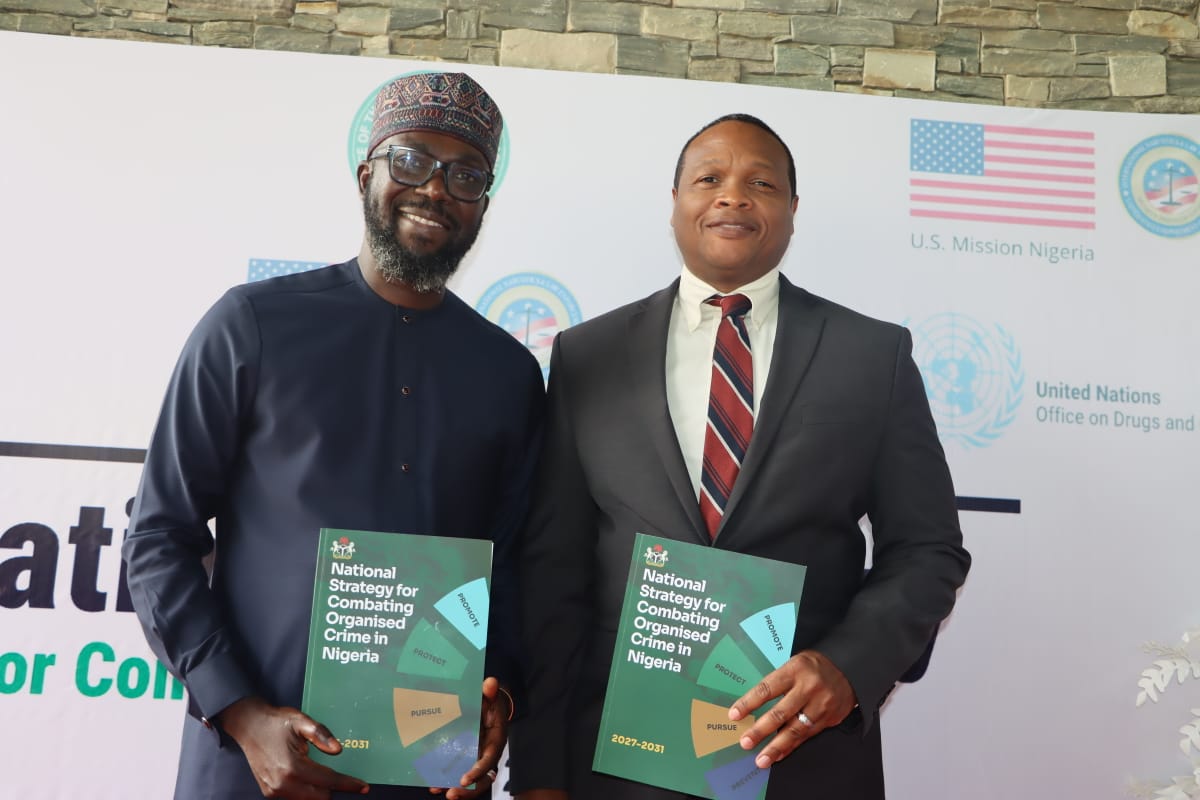
ABUJA — The Federal Government has launched Nigeria’s National Strategy for Combating Organised Crime, with stakeholders calling for stronger inter-agency collaboration, intelligence sharing and coordinated operations to tackle emerging security threats.
The strategy, launched in Abuja on Monday, is aimed at providing a coordinated framework for preventing, detecting, investigating and prosecuting organised criminal activities across the country and beyond its borders.
The initiative was developed through multi-agency consultations with technical support from the United Nations Office on Drugs and Crime.
It focuses on tackling crimes including cybercrime, drug trafficking, human trafficking, migrant smuggling and environmental crimes, while also strengthening measures to protect victims and witnesses.
Speaking at the launch on behalf of the National Security Adviser, the National Coordinator of the National Counter Terrorism Centre, Major General Adamu G. Laka, stressed the need for stronger collaboration among security and law enforcement agencies.
Laka said a coordinated approach was essential to safeguarding national security and maintaining stability.
He noted that no single agency could effectively combat organised crime in isolation, making information sharing, intelligence-led operations and joint investigations critical to the success of the strategy.
The UNODC Country Representative, Cheikh Toure, and the Director of the United States Department of State’s Bureau of International Narcotics and Law Enforcement Affairs, Tolliver Derrick, commended Nigeria for adopting what they described as a whole-of-government and whole-of-society approach.
The approach, they said, was consistent with international best practices for tackling organised crime.
The UNODC said organised criminal groups were becoming increasingly sophisticated, exploiting technology, cross-border networks, economic vulnerabilities and illicit financial flows to expand their activities.
According to the UNODC World Drug Report 2025, about 316 million people globally used drugs in 2023, with criminal groups continuing to expand illicit drug markets into new regions, including Africa.
The UNODC Global Report on Trafficking in Persons 2024 also reported a rise in trafficking victims globally following the COVID-19 pandemic, with children accounting for nearly 40 per cent of identified victims.
The report noted that organised criminal groups remained responsible for a significant proportion of trafficking activities detected worldwide.
Participants at the Abuja event therefore emphasised the need to strengthen regional and inter-agency cooperation, improve specialised capabilities and ensure that criminal justice responses uphold the rule of law.
Presentations by officials of the NCTC, the project coordinator and national consultants focused on the strategy’s objectives, implementation roadmap, the organised crime situation in Nigeria and the Gulf of Guinea, as well as its monitoring and evaluation framework.
The stakeholders agreed that the launch should mark the beginning of sustained action to translate the policy into measurable results.
For communities affected by organised crime, the strategy is expected to strengthen national efforts to protect lives and livelihoods, improve institutional coordination and enhance public safety across Nigeria.