

By our correspondent
ABUJA – President Bola Ahmed Tinubu has declared that Nigeria has moved beyond the difficult phase of his administration’s economic reforms, saying the country has entered a new era focused on widespread prosperity, lower living costs and job creation.
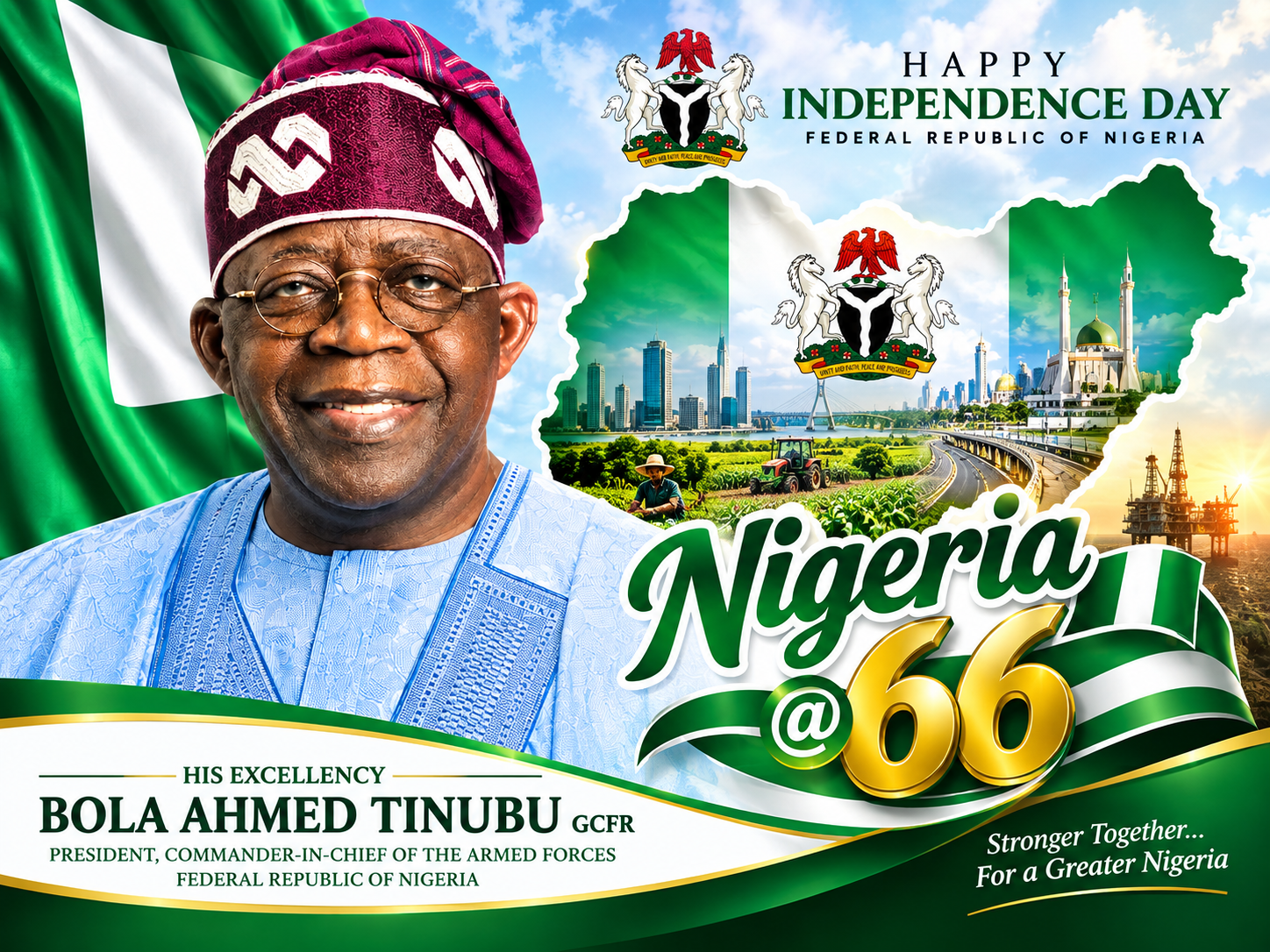
Tinubu stated this in his Independence Day address to Nigerians on Thursday, as the country marked its 66th anniversary.
The President said his administration inherited an economy weighed down by deep structural problems and rising poverty in 2023, insisting that difficult reforms were necessary to correct the country’s economic direction.
According to him, the reforms were painful but unavoidable, likening Nigeria’s economic condition to a cancer patient who must undergo difficult treatment rather than merely take medication to suppress the symptoms.
He said the government had resisted the temptation to reverse the reforms, arguing that doing so would amount to returning to policies that had failed to address the country’s underlying economic weaknesses.
Tinubu said the economic outlook had improved three and a half years after the reforms began, citing economic growth of more than four per cent, reduced oil theft, declining inflation from its peak, stronger foreign reserves and greater stability in the foreign exchange market.
He also said Nigeria recorded more than $6bn in non-oil export revenue in 2025, describing it as the highest level in the country’s history.
The President said the government’s economic priority had now shifted from correcting the nation’s economic course to delivering “shared and widespread prosperity.”
«“The age of reform has done its work. Now begins the age of prosperity,” Tinubu declared.»
He said the next phase would focus heavily on reducing the cost of living by lowering the cost of producing and transporting goods.
Tinubu said the government would expand mechanised irrigation and dry-season farming, improve access to seeds and fertiliser, invest in agricultural mechanisation and strengthen storage and transportation systems.
He added that ongoing investments in roads, railways and ports were aimed at connecting farms and factories to markets and reducing the cost of moving goods across the country.
The President also promised greater attention to industrialisation, employment and enterprise, saying Nigeria’s young population must become a driver of economic production.
He said the government would deploy the country’s gas resources to support industries, revive factories, expand digital connectivity and invest in skills required by employers.
“I want to see more Nigerians making things. I want to see more Nigerian farms feeding our cities and supplying our factories. I want to see Nigerian businesses selling Nigerian goods to the whole world,” he said.
Tinubu, however, acknowledged that millions of Nigerians were still struggling with food, school fees, medical bills and transportation costs.
He said the hardship faced by vulnerable Nigerians was the product of problems that had accumulated over decades, including low productivity, inadequate infrastructure and limited economic opportunities.
“We cannot erase in four years what accumulated over generations. But we can change its course,” he said.
The President said his administration would strengthen social protection programmes and improve the National Social Register to ensure assistance reached Nigerians who genuinely needed it.
He also highlighted the Nigerian Education Loan Fund and CREDICORP as initiatives designed to expand access to education and consumer credit for low- and middle-income Nigerians.
Tinubu said the government would continue working with state and local governments to strengthen primary healthcare, basic education and other essential public services.
He added that salaries and pensions had been paid on time and in full since 2023, while reforms to the national pension system were aimed at improving support for retirees and vulnerable Nigerians.
According to him, the objective was not simply to manage poverty but to ultimately eliminate it.
«“Our objective is not to manage poverty more efficiently. We will defeat it,” he said.»
Tinubu acknowledged that achieving widespread prosperity would take time, sustained economic growth, discipline and the creation of millions of productive jobs.
He nevertheless maintained that Nigeria was now pursuing the fight against poverty from a stronger economic foundation.
The President urged Nigerians not to look back, using the biblical imagery of the “Red Sea” to describe the country’s passage through its difficult reform period.
“Nigeria has corrected its course. We have passed through our own Red Sea. This is not the time to look back,” he said.
He described the Nigeria he envisaged as a country of abundance and opportunity where prosperity would be broadly shared and children could pursue their dreams regardless of their background.
“Our destination is in sight. Our foundations are strong. Our direction is clear. So let us go forward. No looking back,” Tinubu said.