

**…24 Beneficiaries Empowered in 2025, 75% Making Progress in Their Businesses**
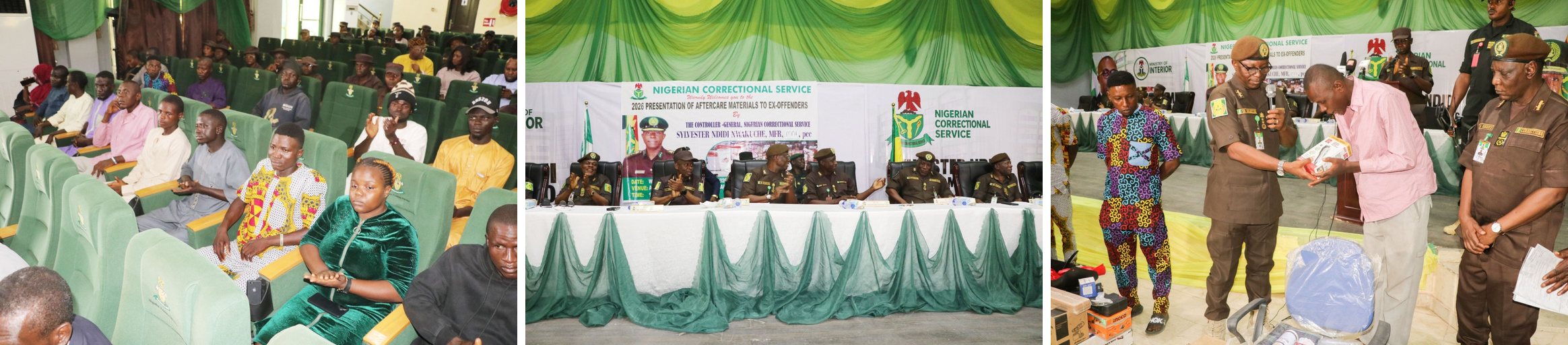
ABIJA – The Nigerian Correctional Service (NCoS) has empowered 33 former inmates with vocational business starter packs under its 2026 Aftercare Programme, aimed at promoting economic independence, supporting successful reintegration and reducing the rate of re-offending among discharged inmates.
The Controller-General of Corrections, Sylvester Ndidi Nwakuche, who presented the starter packs at the ceremony, described the initiative as a practical demonstration of the Service’s commitment to rehabilitation and sustainable reintegration of ex-offenders into society.
Nwakuche said the programme was designed to give beneficiaries a fresh start by providing them with the necessary tools to transform the vocational skills acquired during incarceration into productive businesses and sustainable sources of livelihood.
He stressed that a person’s past mistakes should not determine their future, noting that every individual deserves an opportunity to rebuild their lives and make meaningful contributions to society.
According to him, the responsibility of the Correctional Service goes beyond keeping offenders in custody to preparing them for successful reintegration into society.
He observed that discharged inmates often encounter challenges such as unemployment, economic hardship, social stigma and rejection, which could undermine rehabilitation efforts and increase the likelihood of returning to crime.
He explained that the aftercare programme serves as a bridge between rehabilitation within custodial centres and the opportunities available outside, adding that providing former inmates with tools to practise their acquired skills would strengthen their chances of becoming self-reliant.
The starter packs cover vocational areas including laundry, barbing, tailoring, fashion design, hairdressing, carpentry, masonry, welding and metal fabrication.
The Controller-General described the materials as more than ordinary business tools, saying they represented empowerment, renewed confidence and a pathway to economic independence.
He urged the beneficiaries to use the equipment diligently and responsibly, embrace legitimate businesses and resist negative influences capable of drawing them back into criminal activities.
Nwakuche also called on government institutions, private organisations, religious bodies, community leaders, families and well-meaning Nigerians to support aftercare initiatives and help dismantle the stigma associated with former inmates.
He maintained that the success of the Service should not be measured only by the number of inmates discharged from custody but also by the number of transformed individuals who return to society as productive and law-abiding citizens.
Earlier, the Deputy Controller-General of Corrections in charge of the Directorate of Health and Welfare, Dr Abdullahi Shehu Aldo, said the programme was designed to ensure that no discharged inmate was abandoned at the gate of freedom.
Aldo described the presentation as a celebration of renewed hope and the triumph of rehabilitation over rejection, explaining that the initiative provides beneficiaries with tools, skills, support and mentorship to rebuild their lives.
He appreciated the Minister of Interior for his continued support for reforms in the Service, as well as partners and stakeholders whose contributions had strengthened the programme.
He urged the beneficiaries to make good use of the materials, become worthy ambassadors of the Service and demonstrate through their conduct that positive transformation is possible.
A major highlight of the event was the testimony of Corrections Ambassador, Mariam Omayoza Suleiman, a former inmate of Suleja Medium Security Custodial Centre, who shared how rehabilitation and vocational activities transformed her experience and inspired her to support other former inmates.
Suleiman recounted that while serving her sentence, she observed frequent disagreements and tension among female inmates, prompting her to approach the custodial centre’s management with a proposal to organise vocational activities and competitions to engage them positively.
With the support of the management, she encouraged inmates to showcase their talents, while vocational instructors were invited to train them in skills such as shoemaking, bag production and sweater-making.
She said the activities helped improve relationships among the inmates, reduced tension and created a more productive atmosphere within the custodial centre.
According to her, the experience also exposed her to the difficulties discharged inmates face after regaining their freedom, particularly poverty, unemployment, lack of accommodation and social discrimination.
She explained that many former inmates returned to criminal activities because they had no financial resources or support systems to sustain themselves after release.
Determined to address the problem, Suleiman said she established a small workshop after her release, using the skills and experience acquired during incarceration to engage other former inmates in producing shoes, bags, sweaters and other items.
She disclosed that the Correctional Service had continued to support the initiative through regular welfare checks, exhibitions and opportunities to showcase the products made by the former inmates.
Suleiman appealed to individuals, corporate organisations, foundations and non-governmental organisations to support former inmates by patronising their products rather than simply offering financial assistance.
She noted that providing them with opportunities to earn an honest living was one of the most effective ways of tackling stigma, restoring dignity and preventing recidivism.
She also described custodial centres as places where individuals could undergo positive transformation, urging society not to write off people who had served their sentences.
The NCoS disclosed that 24 inmates were empowered under the aftercare initiative in November 2025, with 75 per cent of the beneficiaries currently making progress in their respective businesses.
The empowerment of 33 additional beneficiaries in 2026 represents another step in the Service’s efforts to strengthen post-release support, promote self-reliance and ensure that rehabilitation translates into lasting social and economic transformation.